The Science Behind Elon Musk’s Internet – Starlink

The Science Behind Elon Musk’s Internet – Starlink
Hey there! Have you ever wondered how Elon Musk’s Starlink is bringing high-speed internet to even the most remote places? Well, it all comes down to some really cool physics—orbital mechanics, radio waves, and laser communication. Let’s break it down in a fun and easy way!
1. Why Low Earth Orbit (LEO) Rocks!
- Traditional satellites hang out at 35,786 km above Earth (geostationary orbit), which leads to laggy internet.
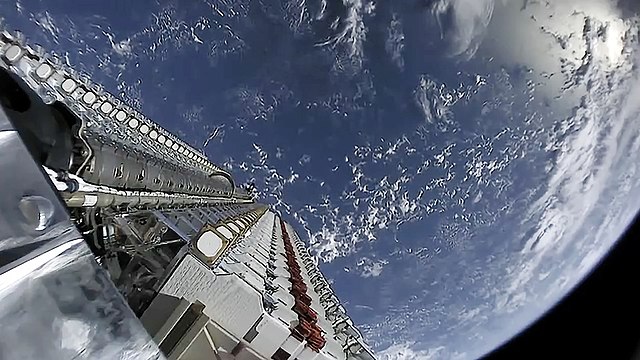
- Starlink satellites cruise much lower, at around 550 km, making connections faster and reducing delays.
- The Physics Part: The lower the orbit, the shorter the distance signals have to travel. That means less lag, making video calls and gaming way smoother! The physics behind this is Kepler’s laws of planetary motion, which govern how these satellites maintain their orbits. Since they are in a lower orbit, they move much faster (about 7.8 km/s) than geostationary satellites, which are almost stationary relative to the Earth’s surface.

2. Beaming Internet with Radio Waves
- Starlink satellites use high-frequency radio waves (microwaves) to send and receive data.
- These waves travel at the speed of light and work on Ku-band and Ka-band frequencies to keep your connection stable.
- The Physics Part: Radio waves are part of the electromagnetic spectrum, meaning they can zoom through space without needing air. However, they can be affected by the Earth’s atmosphere due to Rayleigh scattering and ionospheric refraction, which can degrade signal strength. Starlink mitigates this by using beamforming technology, where signals are directed precisely at the receiving dish rather than spreading in all directions.

3. Space Lasers? Yes, Please!
- Some Starlink satellites talk to each other using lasers instead of ground stations.
- This allows for direct inter-satellite communication, reducing congestion and making connections more efficient.
- The Physics Part: Laser beams use coherent light, which means all the light waves move in sync, allowing for high precision and minimal data loss over long distances. Unlike radio waves, which can be scattered, lasers travel in a narrow beam, which reduces interference. The principle of total internal reflection ensures that signals remain focused and don’t scatter in unwanted directions.
4. How Starlink Dishes Stay Locked In
- Instead of those old-school rotating satellite dishes, Starlink uses phased array antennas to keep track of moving satellites.
- These antennas switch signals between satellites in milliseconds to keep your connection solid.
- The Physics Part: Phased array antennas rely on wave superposition and interference patterns to steer signals electronically—without any mechanical movement. By controlling the phase of the transmitted signals, they can create constructive interference in the desired direction, which allows for nearly instant tracking of moving satellites without lag.
5. Dealing with Weather and Other Challenges
- The Earth’s ionosphere can mess with signals, but Starlink’s adaptive beamforming helps keep things steady.
- Rain, clouds, and even solar storms can impact connectivity, but power adjustments and frequency switching help compensate.
- The Physics Part: As radio waves pass through different atmospheric layers, they undergo refraction, diffraction, and absorption. This can weaken or scatter signals, especially during heavy storms. Starlink compensates for these effects by adjusting transmission power and dynamically rerouting signals through alternate satellites, making use of Snell’s Law to predict and correct wave bending due to atmospheric variations.
Why Starlink is a Game-Changer
- Super low-latency internet: Perfect for gaming, streaming, and video calls.
- Internet anywhere: Great for people in rural areas or places where traditional internet just isn’t an option.
- Future-ready tech: With thousands of satellites working together, Starlink is building a global network that keeps getting better!
What’s Next for Space Internet?
Starlink isn’t stopping anytime soon. They’re constantly launching new satellites, improving speeds, and cutting costs. Whether it’s helping people on Earth or powering future Mars colonies, this is one of the coolest ways physics is shaping our world!
So next time you load a webpage using Starlink, remember—you’re literally sending signals through space at nearly the speed of light. How awesome is that?
 Fotakidis Christos